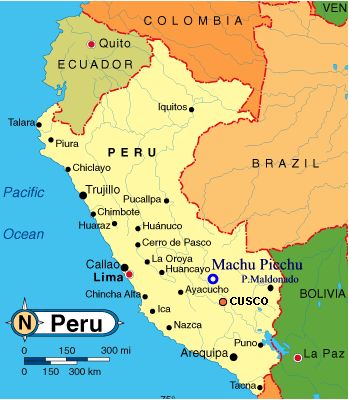
Now that I am back at site and have plenty of free time at night to write blog entries, I’ll give my loyal readers out there a recap of the Dorans’ adventures in Peru the last 2 weeks. I think my mom, dad, Kyle, Pat, and Liz got a little taste of everything, from lomo saltado in Lima to condors in Colca Canyon to altitude sickness in Puno to Irish bars in Cusco. We followed the typical Gringo Trail by visiting Arequipa, Puno, and Cusco but it was a unique vacation for my family and we got to see three distinct areas of Peru. I’ll do my best to recount the trip in order of the places we visited and maybe our experiences can help out anyone thinking about visiting Peru. The whole adventure began in Lima…
Although Lima is the capital, I wouldn’t advise anyone to spend a significant amount of time there. The Plaza de Armas has an interesting history and architectural style, but after a brief tour, my family was ready to move on. We roamed around Parque Kennedy in Miraflores, checked out the Pacific Ocean from Parque del Amor, and had some tasty Pisco Sours at the Rosa Nautica. Later on we went to a typical dance show in LarcoMar at La Dama Juana. It was a really good introduction to Peruvian dance and I even got chased around on stage by a man with a candle trying to light a paper attached to my bum (a typical dance of Chincha). It probably wasn’t as professional as the show Brisas de Titicaca, but since my family got in so late the night before, there was no way they could have stayed awake to see a show that doesn’t even start until 10 pm. And we had to leave super early for Arequipa the next morning.
The next stop was Arequipa, better known as the “White City” for the white volcanic rock used to construct many of the buildings around the main plaza. Getting off the plane, you get an entirely new view of Peru. The city is surrounded by desert mountains and volcanoes but the hub of the city has pristine white buildings and cobble stone streets. After checking into our hotel, we went on a tour of the Santa Catalina monastery. I think at first we were all kind of dreading tours of monasteries and churches, but it was a really interesting tour and a very beautiful monastery. Apparently, the women who got sent there were all from wealthy families and brought with them their own servants, had their own rooms, got sent gifts of gold, etc. If there was ever any convent to want to get accepted into, it was this one- their lives of luxury were far cries from their vows of poverty. But then some head honcho nun changed it all and it became a convent as we know them today. It was definitely worth a visit to the monastery. We got a brief walking tour of the other major buildings around the plaza and after our trip to Colca Canyon we went to the Museo Santury where “Juanita, the Ice Princess” resides. Some archaeologists found a perfectly preserved Incan mummy, a 12 year-old girl (or about 500 years old now), on the top of the mountain Ampato. This museum was one of my favorite places in Arequipa. The artifacts that archaeologists have found and the information they have uncovered of Incan mummies is incredibly fascinating. Definitely a to-do for people visiting Arequipa. Another absolute to-do is eating at the restaurant Zig Zag. It was kind of an unexpected highlight to our trip. We all ended up ordering what the menu called a “trilogy of meats”- alpaca, beef, and ostrich- which arrived on sizzling blocks of stone. I also decided it would be fun to order a peach cocktail that came in a giant ostrich egg. The presentation and the quality of food would make this restaurant a for sure do again.
We only stayed in Arequipa city one night before heading out to the Colca Canyon. It was a day-long bus ride to the lodge we stayed at in Colca Canyon, but along the way you get incredible views of volcanoes, mountains, and rock formations. You also get to spend the bus ride guessing which animals are vicunas, alpacas, or llamas since there are a million along the way. You reach an altitude of over 14,000 ft as well. Thank goodness no one got altitude sickness. The lodge we stayed at had amazing natural hot springs. At that altitude, it’s pretty cold outside, so you never want to leave the thermal baths. I even went in for round two at about 5 in the morning the next day before we left for the Condor Cross. The Condor Cross was still another hour or two away from our lodge, so we left early in the morning along with all the other tourists. We saw a whole clan of condors soaring above the canyon. I’m sure Liz got some fantastic photos. On our way back from the canyon, we stopped to see another clan of condors perched on a cliff. I think they knew I had Choko Sodas and they were waiting to snatch them from me. If we had more time, it would have been interesting to stay another night or two to hike around the canyon. I’ve heard it’s really beautiful, but if you’re trying to do Arequipa, Puno, and Cusco, you’ve got to cut some things out.
We spent one more night in Arequipa before getting on a plane to Puno. Up to this point I forgot to mention that I certainly did not pack well for the weather in Arequipa, Puno, and Cusco. For some reason, I didn’t think that 10,000-14,000 ft about sea level would be cold. I think somewhere in my head I connected vacation with hot weather and brought a sun dress. I was very wrong. It’s realllllly cold in Arequipa and Puno and Cusco. Especially Puno. We were all exhausted the day we arrived in Puno, so after some naps and lunch, Kyle, Liz, and I went to the Sillustani ruins nearby. We kind of winged it and decided to hire a taxi instead of going on a tour (which probably ended up being cheaper anyways). The ruins were a real surprise for me. Since I live near the Chavin ruins and I saw a million Mayan ruins when I lived in Mexico, I wasn’t expecting to be wowed, but the Sillustani ruins were really cool. On top of a high plateau are a series of enormous funerary towers. Llamas roam around the ruins and there are gorgeous lakes on all sides. We got there late in the afternoon, so it was pretty quiet and the setting sun gave the place an almost ghostly feel. I was really glad we decided to venture out to the ruins. We stayed at a hotel that was a little bit of a ways from the center of the city directly on Lake Titicaca, so we ended up sitting in front of the fire and getting some dinner at the hotel that night. Staying right in the center of Puno would have been a different experience. My dad and I went into the center to get some medicine for my sinus infection and the streets were packed with people. We definitely were at a more tranquil location.
The next morning we left for a boat ride on Lake Titicaca. We stopped at the Uros Islands, which are floating islands made out of reeds that the Uros people made to escape the Incas. The islands were really impressive and worth a visit. There a bit touristy (you can even buy Diet Cokes and Snickers on the islands) but the people who live there still speak Aymara and dress in traditional clothing. From the islands, the boat continued on to the Taquile Island. You hike up a giant staircase to the top of the mountain to the main plaza. We happened to be there when the town was celebrating Corpus Christi so we got the chance to see the Taquile people in traditional dress and doing traditionally dancing. At first I thought the celebration and the parade might be something they do every day for tourists, but then I was told it was Corpus Christi. From the top of the island, you can see Lake Titicaca extending for miles and the snow-capped mountains on the other side of the lake in Bolivia. After lunch on the island, we hopped back on the boat. My only complaint on this day trip was that the boat, along with the other tourist boats, was painfully slow. The trip took about 2 ½- 3 hours each way, but I feel like it should take about 1 each way. Maybe we had just had too much travel and long rides at that point for it to be a relaxing boat ride. Nevertheless, it was an awesome trip and I never would have imagined the immensity of Lake Titicaca. We only saw a tiny portion of the entire lake and I suppose it would take several days to get around the whole thing.
After the tour, we all huddled around the fire at the hotel and had a much needed low key evening. An early bed time prepped us for another early wake up call. In the morning, we hopped on the train Andean Explorer to Cusco. If I remember right, the train has been around since the 1930s but has been remodeled on the inside. It was a beautiful 10-hour ride from Puno to Cusco that Kyle unfortunately didn’t get to see much of since he was suffering the wrath of the previous night’s salad. They keep you entertained on the train with a fashion show, live music, and Pisco tutorials, but I was more fascinated by the little towns you pass through and the countryside you get to see. It was an interesting experience and I would recommend it for anyone who wants to see the various changes in landscapes along the way, but it is a long train ride.
Cusco was my favorite city of the trip, which was somewhat unexpected. I was prepared for a city overrun by tourists and street vendors endlessly harassing you with their “home made” souvenirs. It definitely has no shortage of tourists, but it is a city that still clings to its traditional Quechuan roots. We ended up canceling our tour of the Sacred Valley the day after we arrived in Cusco, since Kyle was still recovering and I think we were all recovering from exhaustion a little bit as well. My mom and I walked around the city in the morning on our own, and then in the afternoon we all went on a guided city tour. Pat and I might have grabbed a McFlurry along the way. Later on, we had a briefing with our Inca Trail guide and got packed and ready to go on our 4-Day hike. And what better way to fuel up for a trek? Pizza at Chez Maggy’s. Probably one of the few places in Peru that serves up decent pizza, even though there are a million places that call themselves “pizzerias.” So we packed our bags with the bare minimum and got one last night’s sleep in a bed.
At about 5:30 AM, our guide Jose from Wayki Trek came to our hotel to pick us up. He took us to a small town about an hour away from Cusco to meet up with the other people in our trek group. They had stayed a night in the town where the porters live to see what the life of a porter is like. We all had a very traditional campo breakfast together (toasted corn kernels, potatoes, lima beans, cheese, tea, and quinoa porridge). Then we took off for the starting point which was still another hour or so away. It was a gorgeous drive to the start- you have to drive through the Sacred Valley to get to the start at Km 82. We stopped in Ollantaytambo first to pick up any last minute items. Pat, Liz and I bought walking sticks, which turned out to be really helpful on the trail. So did my 3 Musketeers bar. Right before the start of the trek, we got handed our sleeping bags and mattress that we had rented. We didn’t hire an extra porter, so we had to carry our personal items and our sleeping stuff on our own. Many people hire an extra porter so they can just care a small backpack with water and maybe sunscreen and bug repellent. We decided to be tough guys, which definitely made the second day really hard, but since everything else on the trail was done for us by the porters, it made me feel like I had at least a little more credit. My bag definitely was heavy (or maybe it just felt heavier as the days went on), but it wasn’t unbearable by any means.
The first day was a piece of cake. After getting through the checkpoint, we continued on along the River Urubamba, which had spectacular views of the snow covered mountain Veronica. Jose and his assistant tour guide Victor gave us some history lessons along the way about Quechuan beliefs in the Pachamama, the Mother Earth, the duality, the cardinal points, and the importance of coca. After some pretty flat terrain, we ate our first lunch prepared by the porters. They had a tent, chairs, and a table set up for us, and even had little wash bins with soap so we can could clean up. The food they cooked was great the entire trip, a million times better than anything I could have cooked on the trail. Lunch and dinner always had soup first, garlic bread, some kind of salad, rice, potatoes, or quinoa, and different main dishes like pizza or chicken. After our first lunch, we proceeded on to see the ruins of Llactapata from atop a hill. Then we started our descent down to the first campsite, Wayllabamba, where our tents had already been set up. We even had a “happy hour” before dinner complete with coffee, tea, popcorn, crackers and jam. Dinner was a really good chance to get to know the other people in our group. Three girls were freshmen/sophomores in college, there was a married couple from Australia who had been traveling around the world for 2 years, and then the 3 Dorans and Liz. Our group ended up meshing really well. And I certainly learned a lot about Australia that I didn’t know (turns out Foster’s really isn’t “Australian for beer” as the slogan says, bars apparently don’t even carry Foster’s that often). Having a small group was also a blessing. Most of the groups we saw were pretty large, maybe 15-20 people. Even though they allow 500 people to start the trail per day (including porters, which are half the group), everyone moves at different speeds so you don’t feel like your stuck in this giant mass of gringos. Our guide did a phenomenal job with timing our days. He was always spot on on how many more minutes we had to go and we always got to camp a little before dark so we weren’t waiting around with nothing to do. Since it got pretty cold at night, I appreciated not having to sit around the campsite. It was much better to take a longer lunch break.
The second day of the trek was definitely as hard as they say. I admit, I went into the trek thinking that it must be easy if so many tourists can do it. But the second day was rough. It was basically all uphill, and what makes it hard is that you have to climb up stone steps with all your belongings strapped to your back. I got more than a little sweaty climbing up to the top at Dead Women’s Pass, which is at 4198 m, the highest point on the trek. We took some good photos when we finally got to the top and rewarded ourselves with some mini snickers, goldfish, and Choko Sodas. Fortunately, no one in our group needed to be fed oxygen on the way up like some other hikers. The hike down the mountain to the next campsite at Pacaymayo was not easy either. It was still about an 1 ½ away and was a real knee-ruiner. Good thing I had my wood walking stuck that I bought for a dollar. That night at camp we were all pretty exhausted but pretty stoked we finished the hardest day. We had a lot of laughs playing cards, telling stories, and hanging out.
The next day started with another big hill. Fortunately, we stopped a little ways up to see the ruins of Runkurakay where Jose gave us another history lesson. Runkurakay was apparently a sort of checkpoint for chaskis, or messengers, along the Inca Trail. Then the climbing continued, past a false summit and two small lakes, to a pass at 3950 m. I was totally wiped by the time I got to the top of this pass. My bag felt like it weighed a million pounds. But the views of the Cordillera Vilcamba were incredible and I knew the rest of the way was pretty much downhill. From this pass, we went down to probably the biggest ruins along the way to Machu Picchu called Sayaqmarka. This was a small town and perhaps another checkpoint along the way. After the ruins, we ate lunch at a big campsite and continued on until we reached another pass at 3700m where you can see a fantastic view of the Urubamba valley and the Peru Rail train that brings tourists to Machu Picchu. I also got cell phone service all of a sudden at this point and my phone started beeping like crazy with voicemails. I think at this point I realized how close we were getting to our destination. We passed by another set of ruins on our trek downward called Phuyupatamarka, which have an interesting series of “Inca baths.” We kept going past these ruins and opted to detour to another set of terraced ruins called Intipata before packing it in for the night. Even thought it’s probably 40 minutes out of the way, I would recommend checking these ruins out. The terraces are enormous and offer a great view of the valley below. The last campsite sold beer and had hot showers, although I didn’t participate in either. We thanked our porters after dinner since the next morning was the last time we’d see them and we knew we’d be in a hurry to get to the Sun Gate.
For some reason, there is a gate at the last campsite that doesn’t open until 5:30 AM. Everyone rushes to get up and get to the gate first at about 4:30 in the morning so that when the gate does open, you can run to the Sun Gate to see sunrise over Machu Picchu. So that is exactly what we did. The trail from Winay Wayna, our campsite, to the Sun Gate, normally takes about 1 ½ hours. We did it in 40 minutes. Halfway along the route, we basically started running since sunrise is around 6 AM. We were probably the second group to get there and it was like icing on the cake. We finally caught a glimpse of Machu Picchu with just a touch of sunlight pouring over it. It was absolutely breathtaking. After absorbing as much of Machu Picchu as possible, our group continued on down the path with another objective in mind- to climb Wayna Picchu, the tall mountain in the background of all the well known photos of Machu Picchu. The reason we rushed was because they only allot 400 tickets to go up Wayna Picchu, and anyone who stayed in Aguas Calientes the night before could get up to Machu Picchu and wait in line starting around 6 AM. There’s no way for anyone doing the trail to even get in line before 7 AM. So we sprinted our way down in hopes of getting some of the last tickets to Wayna Picchu. By the time we got there, they were sold out of tickets for the 10 AM entrance but still had tickets for the 7 AM entrance. Hot off the trail, we climbed Wayna Picchu. Fortunately, we were forced to check our backpacks, so we climbed up the steep spiraling stone staircase to the top of the mountain. The view of Machu Picchu from Wayna Picchu is one-of-a-kind, but if you have a fear of heights, this is not a mountain you should climb. It’s actually pretty dangerous and the top of the mountain was not a plateau like I expected- it’s a series of giant, jagged rocks that you kind of have to shimmy over to get across. Most people end up going back down the stairs on their bums it’s so scary. Once we had our fill of the view, we went back down the mountain to the entrance to get some water and snacks after a very full morning. We happened to come across my mom and dad at that point so they got to join us for the tour. Jose gave us a great tour of the ruins and we took tons of pictures. I probably could have stayed at the ruins all day if I wasn’t so exhausted. By about 2pm, most tour groups are gone so it gets pretty quiet at the ruins.
We all took the bus down to Aguas Calientes together and had a goodbye lunch/dinner. The Inca Trail has probably been one of the best things I have ever done and I owe that to my parents for providing me with the opportunity, my brothers and Liz for being wonderful company along the way, and to our trail guide, porters, and trekking mates for making it fun, interesting, and entertaining. The scenery along the trail is unlike anything I’ve every seen and getting to hike through cloud forests, mountain ranges, and Incan temples is a once in a lifetime opportunity. And Machu Picchu is really as remarkable as they say. I wish I was better at words to describe the entire experience, but maybe it’s something that you have to experience yourself.
The town Aguas Calientes at the base of Machu Picchu is, to put it nicely, not a very pretty town. Every tourist has to pass through there by train to get to Machu Picchu, so the town is full of tacky restaurants and artisan shops. However, we stayed at an absolutely gorgeous hotel that somehow was situated in an almost tropical oasis. They have nature walks and ponds right within the premises. The matrimonial rooms had fireplaces and the restaurant had amazing food. The hot springs in Aguas Calientes were so-so, but the pizza at Chez Maggy’s was delicious (I know that was Pat’s favorite!). We took the train back to Cusco the day after completing the trail, and after getting situated in the hotel, Kyle, Liz, Pat, and I went out to celebrate at an Irish Pub called Paddy’s (Pat and I had our eye on this pub from the minute we arrived in Cusco for our post-Inca Trail celebration). We even got to watch a little bit of the NBA finals on ESPN.
Our second to last day in Cusco, everyone but Kyle went on a tour of the Sacred Valley (Kyle stayed home with round 2 of Montezuma’s revenge). I was slightly disappointed with the tour, but it was my own fault I think. I had in my mind that we would be stopping to see several sites in the Sacred Valley but we only really went to the ruins at Ollantaytambo. The ruins and the drive out to see them were amazing, but I think I was hoping for a little more. We stopped from afar to see the ruins of Saqsaywaman, but the ruins of Pisac and other Inca sites were too far away to be included in a one day tour of the Sacred Valley. If you have more time in Cusco, I’m sure doing other day trips to see the ruins around the Sacred Valley are worth it. My mom and dad did some horse back riding and rafting in the Sacred Valley while we were on the trail, so if you don’t do the trail there are certainly other options to get to know the area outside of Cusco.
For our last dinner, we went to a restaurant called Cicciolina, a recommendation by many people around Cusco, and definitely a great place to go. Getting used to being well-fed and well-bathed was not good preparation for going back to my site but the 2 week break from reality was much needed. Our last morning in Cusco, my mom and dad and I watched little kindergarteners doing traditional dances around the Plaza de Armas for the celebration of Corpus Christi. The main plaza in Cusco is my favorite of any I’ve seen thus far. It also has several mini plazas around the plaza which make it an interesting place to walk around. There’s so much to see and explore around Cusco. Of all the places we visited, I would probably return to Cusco first.
My family vacation was better than I could ever have imagined and it was really hard saying goodbye again. It will be at least another 6 months until I see everyone again, depending on if I come home for Christmas or if I can convince them to travel somewhere with me (I know I won’t have to convince my parents!). I’m thinking Argentina for New Years. Why not turn 24 in Buenos Aires? :)
Here are some links to my pictures on facebook. Liz is putting up photos on Picasa and next time I'm in Huaraz I'll put my picutres on Picasa or Shutterfly for better quality.
http://www.facebook.com/album.php?aid=2177375&id=1406276&l=1ba1df35f1
http://www.facebook.com/album.php?aid=2177370&id=1406276&l=1a9757511b
http://www.facebook.com/album.php?aid=2177367&id=1406276&l=6fc03a5730
http://www.facebook.com/album.php?aid=2177357&id=1406276&l=71d3a5dbffhttp://www.facebook.com/album.php?aid=2177399&id=1406276&l=7b139336c4
Site Update: I returned home to find mouse poop on my bed and on my table. I bought a mouse trap and am awaiting the extermination of the mice in my room. I also bought bricks to construct my bathroom and am awaiting a “maestro” to come and help me build it. My host mom says “this weekend.” We’ll see.